Guide · Bowel habits
Toilet stools for pooping: does squatting help?
What the research says about toilet stools and squatting, what the NHS suggests, how to try one, and how to check in your own diary whether it helps you.
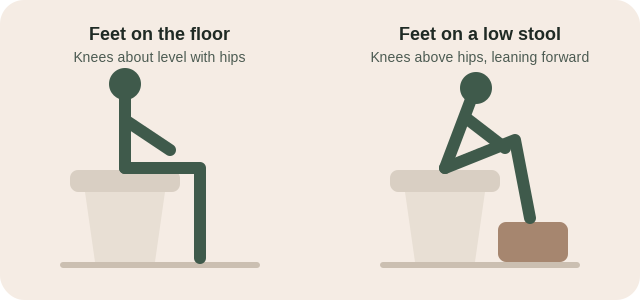
In short: a toilet stool raises your feet so your knees sit above your hips, closer to a squat. Two small studies in healthy volunteers found people strained less and finished faster with their feet raised, and the NHS suggests resting your feet on a low stool if you’re constipated. It’s cheap and low-risk to try. The evidence is limited, though, so the best test is your own: try it for two weeks and note the difference in your diary.
Why posture might matter
When you sit upright on a standard toilet, your hips are bent at roughly a right angle. Researchers think raising your knees, as you would in a squat, straightens the passage out of the body a little and makes it easier to empty without pushing hard. That’s the idea behind toilet stools, sometimes sold under brand names like Squatty Potty.
What the studies found
| Study | Who took part | What they found |
|---|---|---|
| Sikirov, 2003 | 28 healthy volunteers, three positions: standard toilet, lower toilet, squatting | Squatting took less time and felt like less effort than either sitting position |
| Modi and colleagues, 2019 | 52 healthy volunteers, two weeks without a toilet stool, then two weeks with one | With the stool, people reported less straining, a stronger feeling of complete emptying, and shorter time on the toilet |
Both checked October 25, 2026.
What this doesn’t tell us: both studies were small, used healthy volunteers and lasted only a few weeks. People knew which position they were using, which can colour how they rate it. Neither shows that a toilet stool treats constipation, haemorrhoids or any other condition.
What the NHS suggests
The NHS lists posture among its self-help tips for constipation: rest your feet on a low stool while you go, and raise your knees above your hips if you can. It also suggests going at a regular time, allowing enough time, and not putting off the urge. Source: NHS, checked October 25, 2026.
How to try it
- Use what you have. Any sturdy, stable step or box that lifts your knees above your hips will do. A purpose-made toilet stool fits around the base, which some people find easier.
- Lean forward a little and rest your forearms on your thighs.
- Relax rather than push. Breathe normally and give yourself time.
- Keep it safe. If you have trouble with balance or your hips, check with a doctor or physiotherapist first, and make sure the stool can’t slip.
Check whether it helps you
Studies describe averages. What matters is what happens for you, and a simple diary shows that better than memory:
- Keep your usual diary for a week without the stool: date, time and Bristol stool type.
- Then use the stool for a week or two and keep recording.
- In the notes column, write a few words when something stands out, such as “strained” or “felt incomplete”. Our guide on what to write in the notes column has examples.
- Compare the two periods. If nothing changes, that’s useful to know too.
You can use the free printable bowel diary, or Gut Elements on Android to log the type and time in a few seconds, with a note if you want to record how it went.
When a stool isn’t enough
A toilet stool is a comfort aid, not a treatment. The NHS advises seeing a GP if constipation isn’t improving or keeps coming back, if you’re often bloated, if you notice blood in your poo, if you’ve lost weight without trying, or if your bowel habits change suddenly or come with tummy pain. Source: NHS, checked October 25, 2026.
Piyush Sachdeva is the founder of Gut Elements and the accountable editor of this guide. Diagnosed with celiac disease at 13, he has spent most of his life learning how much his days depend on his gut, and built Gut Elements as the simple, private bowel tracker he wanted. He is not a doctor or dietitian; he shares his own experience, not medical advice.